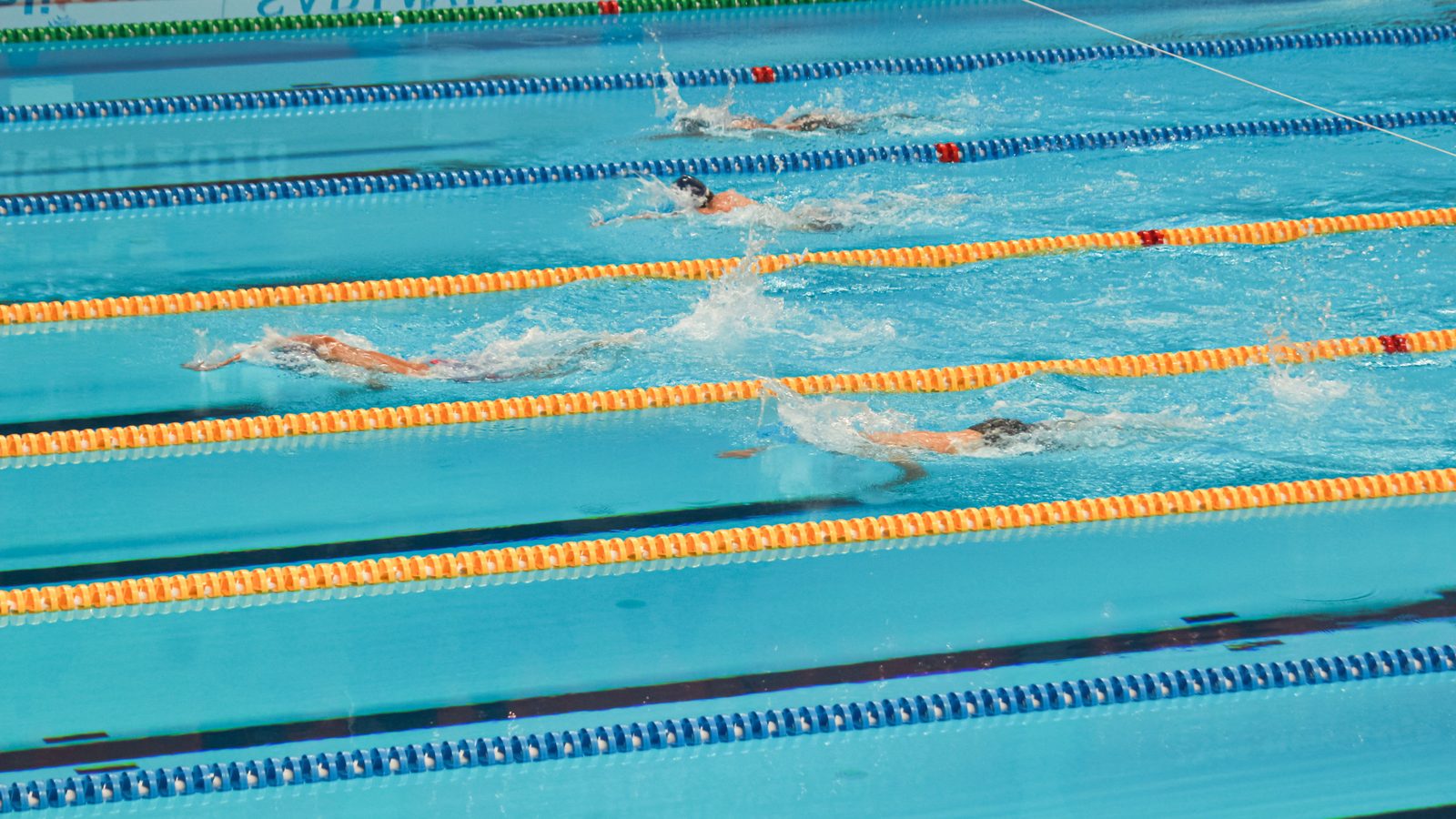
Last Saturday (August 15), in the men's 1500m freestyle final at the European Swimming Championships in Paris, 19-year-old German swimmer Johannes Liebmann touched the wall and the clock lit up 14:26.79.
That's 3.88 seconds faster than the world record of 14:30.67 Bobby Finke set at the 2024 Paris Olympics, and it made him the first man in history under 14:30. Even crazier, it's 12.88 seconds faster than the PR of 14:39.67 he'd set just four months earlier.
Watch on YouTube 2026 European Swimming Championships, Paris: Men's 1500m Freestyle Final (Full Race)The whole record-breaking swim is right here. Watch how steady his stroke rate and turns are through the middle of the race. (The uploader doesn't allow embedding on other sites, so you'll need to open it on YouTube.)
The reaction on social media was unanimous: a prodigy, out of nowhere.
At first I read it as just another news story. But the swim was so unbelievable that I couldn't help digging into him: his results over the years, post-race interviews, German media coverage, the official split times. I just kept digging.
And I found a detail that made the story a lot less simple. Liebmann has recalled that the first time he raced the North German multi-event swimming championships, he finished 51st out of 60.
How does a kid who placed 51st out of 60 go on, years later, to take nearly 4 seconds off the world record? The more I dug, the more I felt this story deserved a proper write-up, and I wanted to come at it from two angles:
If you have a young athlete at home, what is this story telling you?
If you're an age-group triathlete like me, what can we learn from a 19-year-old swimmer?
First, the Rest of the Story: How He Caught Up
Liebmann was born in 2007, and he got into swimming for a very everyday reason. When he was little, he and his sister wanted an inflatable boat. Their dad's condition: if you want a boat, learn to swim first.
From that 51st out of 60, he joined Elmshorner MTV and slowly started making a name for himself in German youth racing. In 2022 he swam 15:43.44 in the 1500 at the German Short Course Championships. In 2024 he went 15:04.04 at the European Junior Championships and took silver.
The real turning point came at 16. When the training setup back home started to change, he went to Magdeburg for a trial and ended up deciding to leave home and stay. SC Magdeburg is a powerhouse of German distance freestyle. Coach Bernd Berkhahn's group includes world-class swimmers like Lukas Märtens, Florian Wellbrock, and Oliver Klemet. Interestingly, Berkhahn started his coaching career in Elmshorn and only moved to Magdeburg in 2012, so Liebmann basically retraced his path.
When he first got there, he couldn't keep up. By the back end of a training week, he often couldn't even finish the sets. He described that stretch like this:
"The first few months were tough, because everyone else was too fast for me. But I kept trying to keep up."
He didn't lower his standards, and he didn't leave. He started watching: how the faster guys swam, how they trained. Then he worked it into his own training, bit by bit. This April, he finished the thought: "In the last few weeks, we've been on the same level."
Here's how his times went from there:
- 2022: 15:43.44
- 2024: 15:04.04
- 2025: 14:53.15
- April 2026: 14:39.67
- August 2026: 14:26.79
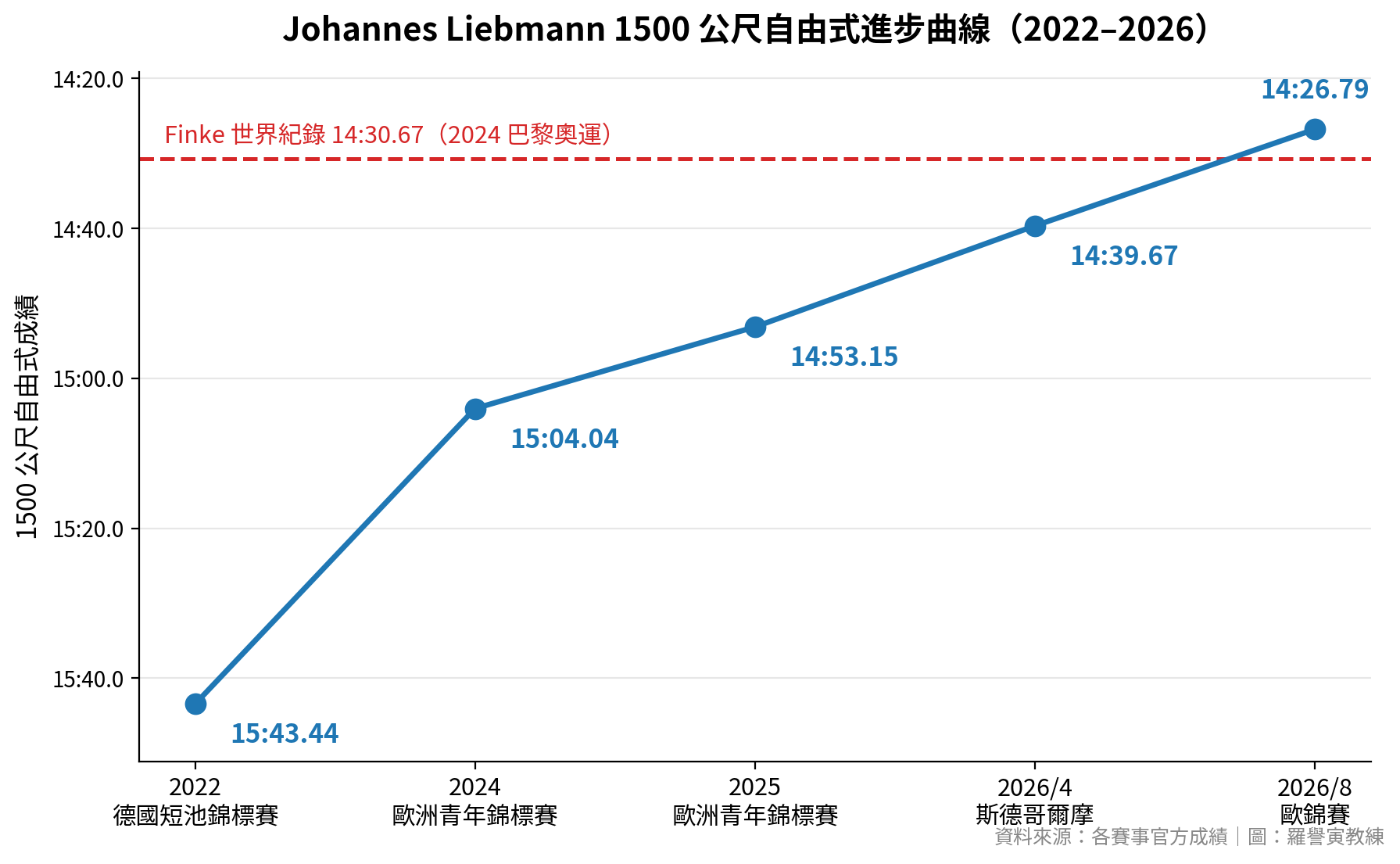
From 14:53 to 14:26 in less than a year and a half. And the improvement wasn't limited to the 1500. In late 2025 he swam 7:30.47 in the short course 800, a world junior record. In April 2026 he put up 3:44.59 in the 400, 7:37.94 in the 800, and 14:39.67 in the 1500, all at once. At these European Championships, he first won 800 gold in a European record of 7:37.59, and three days later he took the 1500 down to 14:26.79.
His 400, 800, and 1500 all got faster together. His speed and his endurance grew up together.
And through this entire season, he was still in Magdeburg studying for his Abitur, the German high school graduation exam.
That's the story. Now for what this article is really about.
Three Reminders for Training Young Athletes
1. Where a Kid Places Now Predicts Almost Nothing
A kid who placed 51st out of 60 sets a world record years later. In youth sports, that's not unusual. Results around puberty are a mix of early or late development, years of training, and differences in body size, and they have very little to do with an athlete's ceiling as an adult. We've all seen kids who crushed everyone their age and then vanished from racing as they grew up. We've also seen late bloomers who got left way behind for years and then suddenly came into their own after 20.
So the questions parents really need to ask don't have much to do with placings. Does your kid still want to train? Are they training in a healthy way? Are they still improving?
2. Build All-Around Ability in the Teen Years Before Narrowing Down to One Event
Liebmann didn't only get faster in the 1500. His 400 and 800 improved right along with it. That's key, because a world-class 1500 was never only about hanging on. You need a high enough top-end speed first, or you can't hold a very high average speed for that long.
Developing speed, aerobic fitness, and technique together in the teen years pushes a young athlete's future ceiling higher. Jumping too early into distance-specific training that just piles on volume might produce good results in the short term, but it nails the ceiling in place ahead of time.
3. The Environment Matters More Than Any Training Plan
Moving to Magdeburg at 16 changed a lot more than his training plan: the standard he faced every day, his training partners, and his sense of what fast even means. Watching a world champion swim from the pool deck is one thing. Doing the same set alongside world champions every day is something else. Day after day of training, the second one slowly becomes your normal.
There's an order of operations here worth noticing. He went into a high-level environment first, let his weaknesses get exposed, and then built the ability to catch up to it. Most people's instinct runs the other way: wait until the kid is good enough to earn a better environment. Liebmann's case is a reminder that the environment is the soil ability grows in. Treat it as a prize for ability and you've got the order backward.
Of course, changing environments has costs. Leaving home, switching schools, the risk that it doesn't work out: those are all real, and not every 16-year-old would last in Magdeburg. It's a decision you have to weigh. When you do, though, the first question should be whether the new environment will let your kid keep growing.
What Can Age-Group Triathletes Learn from This?
You might be thinking: I'm not 19. Growth spurts and pro-level training volume have nothing to do with me.
Fair enough. But three things here have nothing to do with age.
1. Go Be the Slowest Person in the Group
In his first few months in Magdeburg, Liebmann couldn't keep up. And that stretch of not keeping up is exactly where his fastest improvement started.
Now turn it around on yourself. When was the last time you were the slowest one in a workout? After a few years of training, a lot of age-groupers drift into a group where they're always near the front without even noticing, because it's comfortable there. But who you train with every day shapes your sense of what fast is. Train only with people slower than you for long enough, and your normal slowly slides downhill.
Find a group ride that makes you suffer, or a lane where you're the last swimmer. Then do what Liebmann did: watch what the faster people are doing, and don't rush to prove yourself.
2. Your Long-Course Results Are Built on Top-End Speed
This is the most common blind spot for age-group triathletes: 70.3 and full distance are long, so they pile on Z2 and only do long sessions.
But Liebmann's progression makes it pretty clear. His 1500 got faster along with his 400 and 800. Apply the same logic to triathlon. If you want to hold 5:30/km on a full-distance marathon, your 10K ability had better be well clear of that pace. Athletes who cruise right up against their ceiling usually blow up in the back half. If your top-end speed isn't high enough, all the aerobic volume in the world just makes you better at hanging on to the finish.
Even if you're training for long course, high-intensity intervals shouldn't disappear from your plan. What they build pays off late in the race.
3. Real Endurance Means Controlling Your Output Under Fatigue
Look at the official splits from his record swim. He went out in 54.89 for the first 100 (Finke's was 55.47) and hit 400 in 3:48.38, a full 2 seconds ahead of Finke at the same point in his record swim. He closed with a 56.18 final 100 (28.79/27.39). The swimming fan page Youyong Duoduo crunched the numbers on all 15 of his 100s. Leave out the first and the last, and the middle 13 averaged 58.13 seconds. A typical 100 was only 0.235 seconds off that average, a variation of just 0.4%. From 500 m on, every single 100 landed between 58.01 and 58.35 seconds, an unbelievably narrow window.
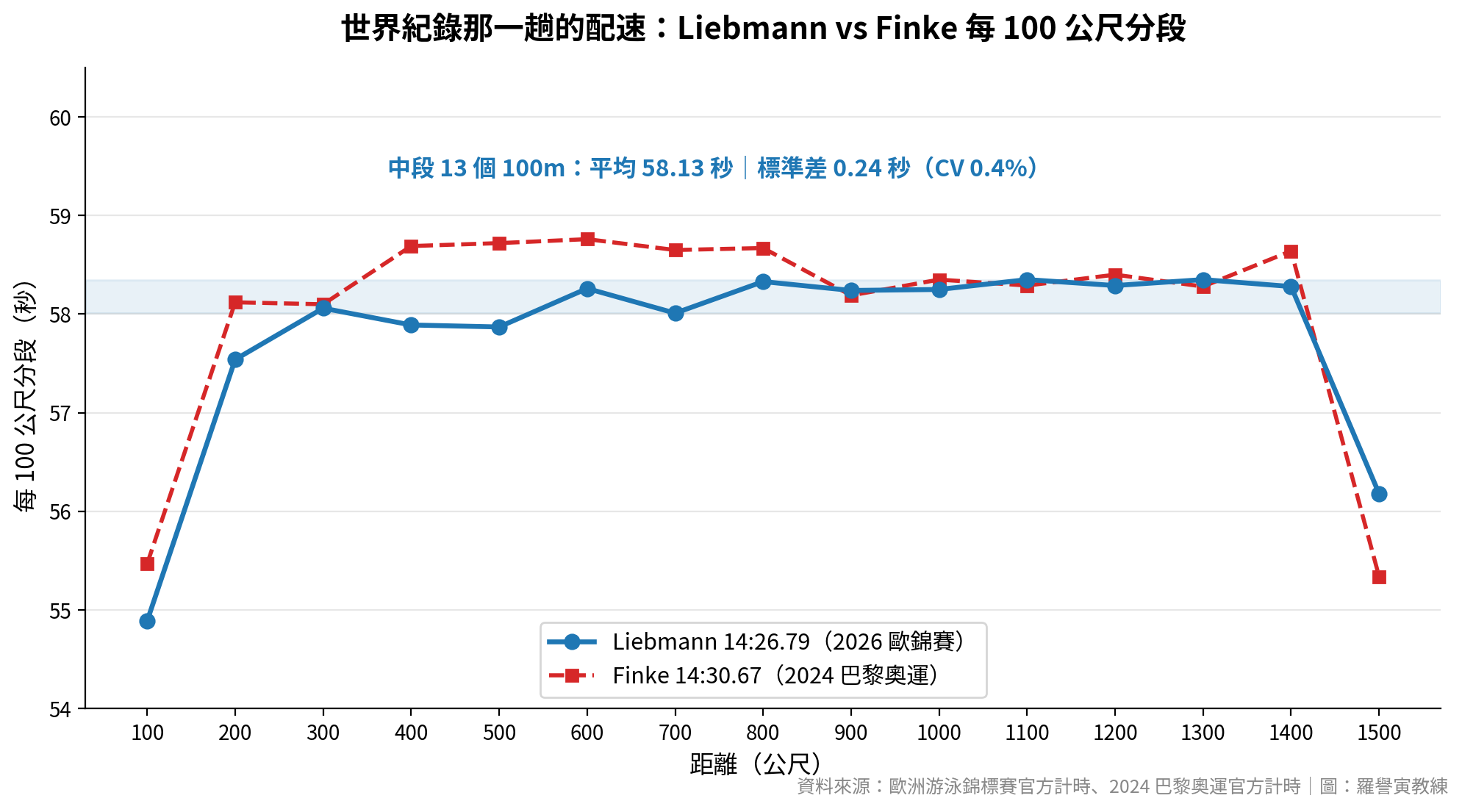
Lay the two lines on top of each other and there's one more detail: Finke actually closed faster over the last 100 (55.34 vs. 56.18). Liebmann won this record with a decisive first third and a nearly flat line of pacing through the middle.
This record didn't come from a big final 100. It was built on 1,400 meters of very high-quality output before that.
In triathlon, this is exactly why, when I set a full-distance bike strategy for my athletes, I always want normalized power (NP) and average power (AP) as close together as possible. The smaller the gap between those two numbers, the smoother you rode those 180 km. The time age-groupers lose in a race usually has little to do with whether their average power was high enough. The problem is surging and easing off. That rush you get from pushing an extra 30 W up a climb gets paid back with interest in the back half of the run. It's the same thing I wrote about in durability: what decides your result is how much you have left once you're tired.
In endurance racing, the quality hides in the least exciting part of the race: the middle. Whoever can keep controlling their output and hold their technique as the fatigue piles up is the one who turns all that training into a result.
Final Thoughts
When Liebmann arrived in Magdeburg at 16, he was the guy who couldn't finish the sets at the end of a training week. Two years later, he's a rival the Märtenses and Wellbrocks of the world have to deal with.
14:26.79 is a number.
For parents and coaches of young athletes, though, the point of this story is this: don't rush to judge a kid by where they place now. First ask where their next environment is.
And for those of us age-group triathletes who are well past any chance of a growth spurt, the point might be even simpler. The kid who placed 51st out of 60, and who later chose to move somewhere he'd be the slowest on the team, used methods every one of us can afford: find a stronger environment, raise your top-end speed, and in the most boring middle stretch of the race, hold your output.
Editor's note: Athletes' results are compiled from official meet results. The 1500m splits come from official timing at the European Swimming Championships and the 2024 Paris Olympics. The average and spread of the middle 13 100s are from an analysis by the fan page Youyong Duoduo. Liebmann's two quotes are from an April 2026 interview with German swimming media. Both charts were drawn by the author from the data above.