

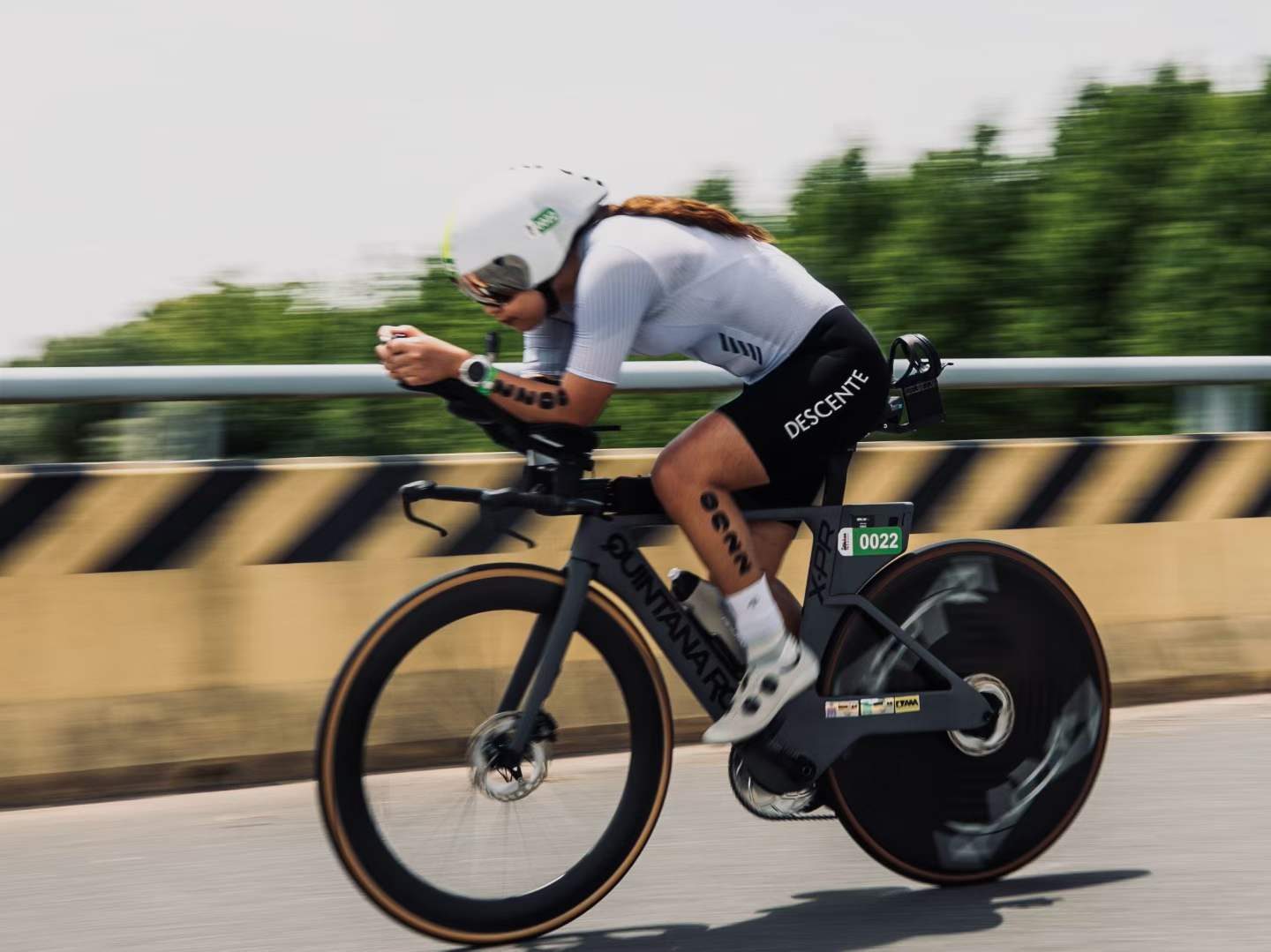
Once you start training with a power meter, you'll run into three letters sooner or later: FTP. It stands for Functional Threshold Power, a concept first put forward by Dr. Andrew Coggan, the leading authority on power-based training. In plain terms, it's the highest average power you can hold for roughly an hour at a steady effort without fading. It's measured in watts.
I've been coaching for a lot of years, and I keep telling my athletes the same thing: FTP is the foundation of your entire power-based plan. How hard you warm up, where your intervals sit, how easy your recovery rides should be, what power you race at. Almost every intensity on your schedule is calculated from FTP. If the foundation is off, every number built on top of it is off too.
What FTP Actually Measures
A lot of people think FTP is just "your one-hour power." What it really lines up with is a concept from exercise physiology: lactate threshold.
Here's an analogy. Picture your body as a funnel with a small hole in the bottom, and lactate as water being poured in. At low intensity, the water goes in slowly and drains out the hole as fast as it comes in, so almost nothing builds up. That's your body producing lactate and clearing it just as fast, and you can keep going for a long time. Push the intensity up and you pour faster. Once you're pouring faster than the hole can drain, water starts to pool. The point where it starts pooling is your lactate threshold.
Go past that point and lactate builds up fast. Your heart rate climbs, your breathing gets short and ragged, your legs start to burn and feel heavy, and slowing down is only a matter of time. FTP is the highest power you can hold right around that line without getting swamped. It's a different thing from how many watts you can squeeze out in a sprint. One is about how long you can hold on; the other is how hard you can hit for a moment. The higher that line sits, the higher the cruising power you can hold in a race, and in endurance sports that's the most valuable ability you can have.
It's also why most of the numbers on your power meter (every training zone, the target watts for each interval, TSS, even the fitness curve on your PMC) are calculated off FTP. Get FTP wrong and all of those numbers drift with it. You think you're dutifully riding in Zone 3 when you're actually well into Zone 4. That's why retesting regularly matters so much.
For reference, pro cyclists often sit at 360 to 400+ watts, while most age-group cyclists land somewhere between 250 and 320. Don't read too much into those absolute numbers, though. The same wattage feels completely different for a 60 kg rider and an 80 kg rider. What you should watch is where your own FTP goes as you train.
Your Zones Drift as Your Fitness Changes
The catch is that FTP isn't a number you test once and keep forever. After a few weeks of consistent training, your aerobic fitness improves and watts that used to hurt start to feel easy. On the flip side, time off the bike or the fatigue that piles up after a big block can pull it down. If you're still training off a number from three months ago, one of two things happens:
- Your FTP is set too low: every interval ends up too easy, the training stimulus isn't enough, and your fitness stalls.
- Your FTP is set too high: you can't hold the watts the workout asks for, you blow up rep after rep, and all you get out of it is fatigue and frustration.
Treat FTP as a calibration tool, not a report card. The point of retesting is to put every intensity right where it belongs.
In other words, the most practical reason to retest FTP is to make sure every session that follows matches the body you have right now. Whether the number goes up is secondary. Training in the right place is what counts.

How Often Should You Test?
For most age-groupers, I recommend testing every 6 to 8 weeks, usually at the start or end of a training block. It's also worth testing early if:
- You're coming back from a long break or an injury, and your fitness has clearly changed.
- Your zones have felt off for several sessions in a row, either too easy or impossible to hit.
- You're heading into race season and need an up-to-date basis for pacing.
Note: 6 to 8 weeks is the default for athletes who are new to power and haven't built up much data yet. Once you can read your own day-to-day data, you can switch to testing only when you see signs of improvement: same power, same perceived effort, noticeably lower heart rate.
How to Test, and What to Do With the Number
There are two common protocols. One is a 20-minute all-out effort after a thorough warm-up, taking 95% of your average power as your FTP. The other is a ramp test on the trainer: after warming up, the resistance goes up one step every minute until you can't turn the pedals anymore. Warm-up and cool-down included, the whole thing takes about 25 minutes. The system converts the best one-minute power you held: TrainerRoad and Zwift both take 75% of that peak as your FTP.
To be honest, the 20-minute test works best for athletes who already pace well. You have to know how to spread your effort evenly across those 20 minutes. Go out too hard and blow up late, or play it too safe and never empty the tank, and the number comes out wrong either way.
After all these years of coaching, I actually prefer the ramp test. You don't need pacing experience to get a good result, and it's a lot easier on athletes, mentally and physically. The part where you really have to dig in is only the last two or three minutes, and you recover much faster afterward. You don't walk away wrecked the way you do after a full 20-minute effort.
The most common knock on the ramp test is that it overestimates FTP, but that mostly happens with sprinters who have a big anaerobic engine. The ramp test works backward from your short-duration max power. Triathletes tend to be endurance engines without much anaerobic punch, so for us the risk usually runs the other way: it's more likely to slightly underestimate your true FTP (your one-minute peak isn't that high, but you can hold a big share of it). When you're building a training plan, erring on the conservative side is safer than overestimating. Worst case, a few sessions end up a little easy. You won't be blowing up rep after rep. If you want it dialed in, check the result against the power you actually hold in long intervals or in races, and adjust the number a bit.
Whichever protocol you use, stick with the same one every time, with the same equipment and the same setup, so your numbers are comparable.
Once you have the result, don't let it sit there. Update your new FTP in TrainingPeaks or on your head unit so every zone recalculates automatically, and your upcoming workouts will match your current fitness. Get this step right and every minute you train actually pays off.