
Why Race Two Full-Distance Races Back to Back?
Anyone who knows me or has trained with me knows I strongly advise against racing two full-distance (226 km) races too close together, whether you're racing to finish or to compete. First, races this long take a huge toll and recovery takes a long time, so racing both of them well is extremely hard. Second, hours of repetitive movement on muscles that are already badly fatigued carries a high risk of injury. Third, even if your body bounces back, the mental load is enormous. It's a serious test of willpower. I'm pretty sure no coach or textbook would ever have you race two full-distance races that close together.
But real life is full of buts. My first race this year, Challenge Taiwan, was one I'd signed up for back in 2024. Then my son was born in 2025, so I deferred to this year. On top of that, I really wanted another shot at Kona qualification (KQ). The only time I raced the World Championship in Kona, in 2022, I raced sick. This year a lot of my athletes are heading to Kona, and I wanted to go with them and make a new memory there.

Starting late last year, I went through every IRONMAN race around the world, over and over. With a kid to bring along, I couldn't fly too far, so it had to be in Asia. For personal reasons, I really didn't want to race IRONMAN Taiwan in Penghu. That left one hope: the first-ever IRONMAN Vietnam in Da Nang this year.

Then I noticed it was only two weeks after Challenge Taiwan. Like I said, I really don't recommend putting two important races that close together, especially when both of them matter. But you're only young once, right? Sure, I'm already 33 and I have a kid, but sometimes you have to go a little crazy for a dream. And with ten years of coaching behind me, I was still confident I could get ready for both.
How I Prepared
After running the Macau Marathon in early December last year, I took a week off and then officially started a 21-week build for these two races. Since my son was born, every day has been packed. On weekdays I can only work and train while he's at daycare, and squeezing in an hour or two of training a day is already pretty good. On weekends I try to spend as much time with my family as I can, so my long sessions couldn't get very long.
Here are my training hours for the build (including one 70.3 in Hengqin and both full-distance races):


All my training is public on Strava. Everything's logged honestly: nothing left off, no secret sessions. A lot of the time I was just too wiped out from looking after my son, hadn't slept well, or was sick, and I skipped workouts. For the long sessions that matter most in a full distance, my longest ride was a single 3:35 indoor session on April 4. Every other long ride was under 3 hours. My longest run was 23.7 km on March 29, in 1:51, and most of my other long runs were 20 km. I didn't train this little because I thought it was enough. Most of the time I had to cut sessions short because I wasn't in good shape (sick or short on sleep).
Did training this little make me nervous? Honestly, going into Challenge Taiwan, I didn't have much confidence. I had to take it as it came and execute every part of the race as well as I could. Switching to coach mode, all I could tell myself was this: "Training isn't about how much you do in one session. It's about what you build up over time, and even more about quality. Every stroke, every pedal stroke, every breath: were you fully in it? Did you hold your form? If you've given it everything you have, then go out and execute it on race day!"
Race One: Challenge Taiwan
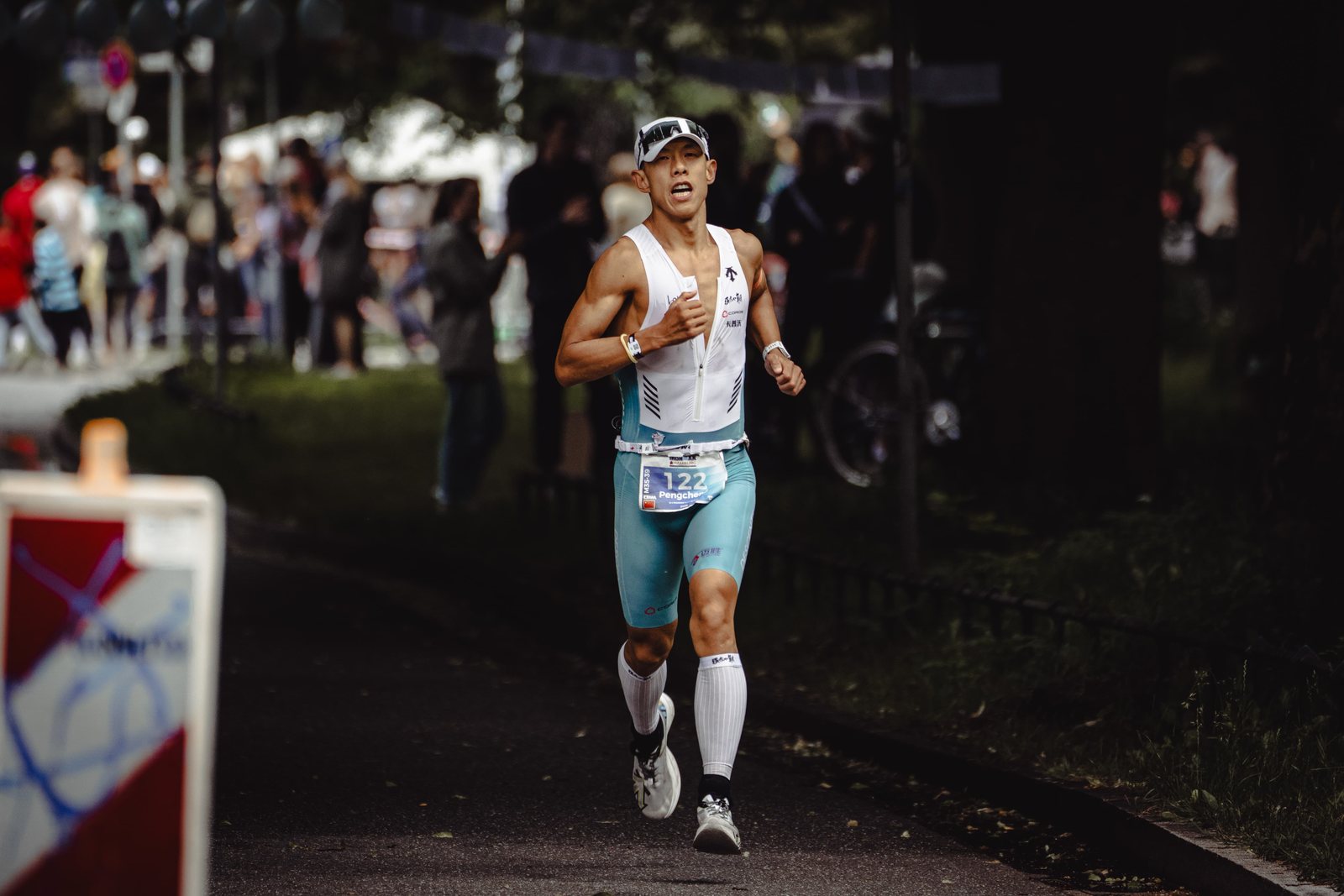
The original plan was to treat Challenge Taiwan, two weeks out from Da Nang, as an extra-long training day. Wetsuits were allowed, but the water in Da Nang would be far too warm for one, so to simulate that, I swam in a speedsuit. I went in pretty relaxed and swam 1:16, my second-slowest ever. A little disappointing, but it really did feel easy. Then the weather turned in my favor. The wind on the bike was lighter than expected and the temperature was lower. It rained pretty hard, but riding at my target power, I finished the first 90 km lap in just 2:16, my fastest 90 km ever. Right then I decided to grab the gift I'd been handed and update my PR, as long as I didn't push my body too hard.

The plan changed on the fly. It might hurt my race in Da Nang two weeks later, but weather this good for a fast time doesn't come along often. Miss it, and who knows if you'll ever get another shot. The original plan was to drop the power on the second lap and save my legs. What actually happened: I held my target power of around 180 W and rode the 180 km in 4:33, a huge bike PR, averaging 39.4 km/h.

Off the bike, I did some quick math. To break the full-distance PR I'd set three years earlier, 9:33, I only needed to run under 3.5 hours. But I was second overall, just a few minutes behind the leader, Justin. He's a strong runner, but if his run went sideways and I kept mine steady, I still had a shot at the overall win! I changed the plan again and went for it. I ran the first half in just 1:33. A month earlier, at IRONMAN 70.3 Hengqin, I'd only run 1:31 for the half marathon, though I didn't taper for that race. Clearly my rival wasn't easing off either, though, because the gap didn't come down.

Just when I was getting tired and about to let it go and jog it in, I passed the turnaround at 26 km and saw I'd suddenly closed the gap by 2 minutes. That meant he was starting to struggle, too. In that moment, the fire came back, and I pushed back up to race pace. I don't know how my body held on that long. Maybe deep down I really wanted to win one, for myself, for my son, and for Macau! After 35 km my body was clearly running out of gas, and only willpower was keeping my form together. All I could think about was getting to the finish so my wife and son wouldn't have to wait too long. I finished at close to full effort. The clock stopped at 9:15:17, a PR by 18 minutes, and the fastest marathon I've ever run in a full distance.


In the end, everything lined up that day, and I came away with a pile of PRs: my best and second-best 90 km bike splits (2:16 and 2:17), my best 180 km bike, my fastest full-distance marathon (and maybe my fastest first half, too?), and my best full-distance time. What a haul.
Race Two: IRONMAN Da Nang
After Challenge Taiwan, I took three full days off. Everything after that was really just recovery. All I could do was short, low-intensity aerobic work, plus heat acclimation for the Da Nang weather. I also had to get enough nutrition in: plenty of carbs and protein at meals, plus extra vitamins, minerals, fish oil, and other anti-inflammatory supplements, to help my body recover as fast as possible.

Since I'd gone close to all-out in the first race and already had my PR, I showed up in Da Nang without much pressure. My goals were the podium and a Kona slot. Under the new system, only age-group winners get a Kona slot directly. Everyone else goes into a performance pool and competes in the roll-down together. That's a real disadvantage for me in M30-34, because it's the only age group with no adjustment factor. Someone who finishes 30 minutes behind me, or even an hour or two, can still rank ahead of me in the pool.
That gave me three possible race scenarios. Best case: I come off the bike leading my age group by 10 minutes or more. Then I'm confident I can run steady and lock up the slot. Second: someone is just ahead of me off the bike, and I have to run all out to chase them down and finish first in my age group. Reality handed me the worst case. Off the bike I was more than 10 minutes behind the leader, and he's a strong runner, too. A direct slot was out of reach. That meant competing for Kona against everyone else in the performance pool, and it meant I had to fight for every second of those last 42 km to move up even a little in the pool rankings.


Back to the start of the race. This IRONMAN ran on the same day as the 70.3. The 70.3 went off first at 5:45, and the full distance started at 6:30, which meant the sun was already high by the time we started swimming. Luckily the water wasn't too rough that day, the swim wasn't very hard, and I had a group at my pace to swim with. I was out of the water in 1:07, my fastest full-distance swim ever. After the race I found out the course was about 200 m short, but it was still the best swim I've had in a race so far.


Looking back at the IRONMAN Tracker, I came out of the water 8th in my age group (75th overall). A solid start. Next came the bike, where I'm more confident. It's two laps, mostly flat, with four climbs over the Thuan Phuoc Bridge. The first lap went really well. I did it in 2:20, the fastest lap in my age group, and moved up to 3rd. But in the heat and humidity, I was losing fluid faster than I'd expected. From then on, I had to slow down at every aid station and grab two bottles of water or sports drink just to quench my thirst. My electronic shifting started acting up, too. It kept randomly losing connection and wouldn't shift, so for a long stretch I had to ride at a cadence I'm not used to. On the last climb up the bridge, I had to grind it out at 40 rpm. The second lap took 7 minutes longer, and I finished the 180 km in 4:47, 2nd in my age group (22nd overall) and 14 minutes behind the leader.


Coming out of T2, my wife told me where I stood. I had to face the worst case after all. Fourteen minutes. You could just give up right there and settle for keeping your podium spot. But if this were one of my athletes, I'd tell them to keep fighting to the end! In a race this long, in heat and humidity like this, anything can happen. Who knows if the leader blows up on the run? You only get a shot if you keep going, and I also had to fight for every second for my ranking in the performance pool.

The run is four out-and-back laps on roads with no shade. At that point it isn't only a test of fitness. A big part of it is mental torture. Even if your legs still have something left, the moment your mind gets a little weak, you're beaten. After the first lap I honestly wanted to quit. At the turnaround I saw one of my athletes, Cao Pro. He'd just won his age group in the 70.3, and he still came out in the afternoon to cheer me on. When you're at your weakest, every bit of cheering really helps. I pulled myself together and kept going at my own rhythm. I wanted to set an example for my athletes: no matter how bad it gets, keep going!


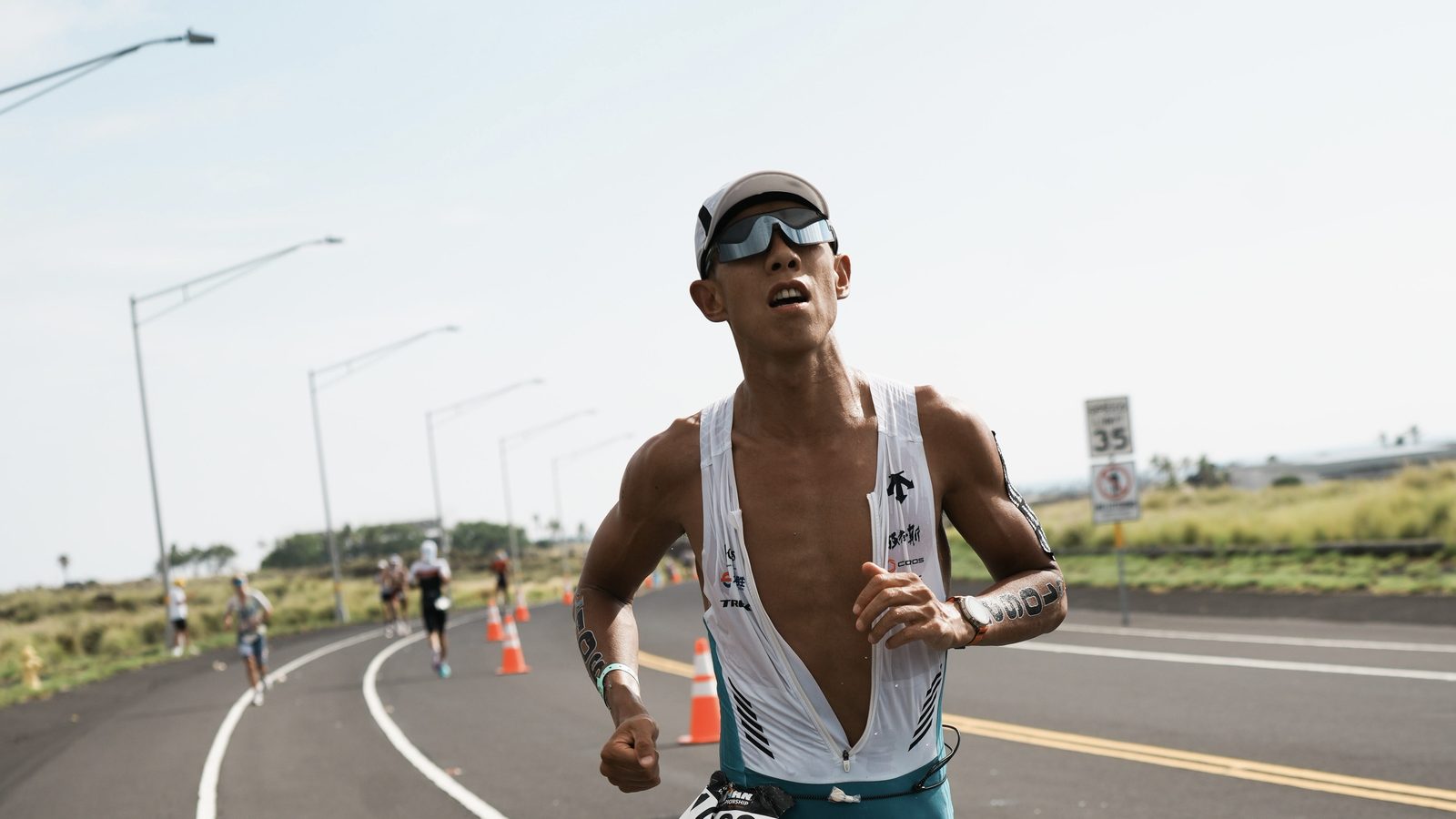
How hot was it? Almost everyone in this photo is walking or barely shuffling, and you want to stop and walk, too.
One lap, two laps, three laps. Time slowed way down. Every kilometer, I was counting how many were left, and at every aid station, all I could think about was how far the next one was. On the last lap, I didn't even know what the gap was anymore. All I knew was that I couldn't stop for a single step. I fought through the fatigue and the soreness, dug out every last bit of energy I had, and kept running.

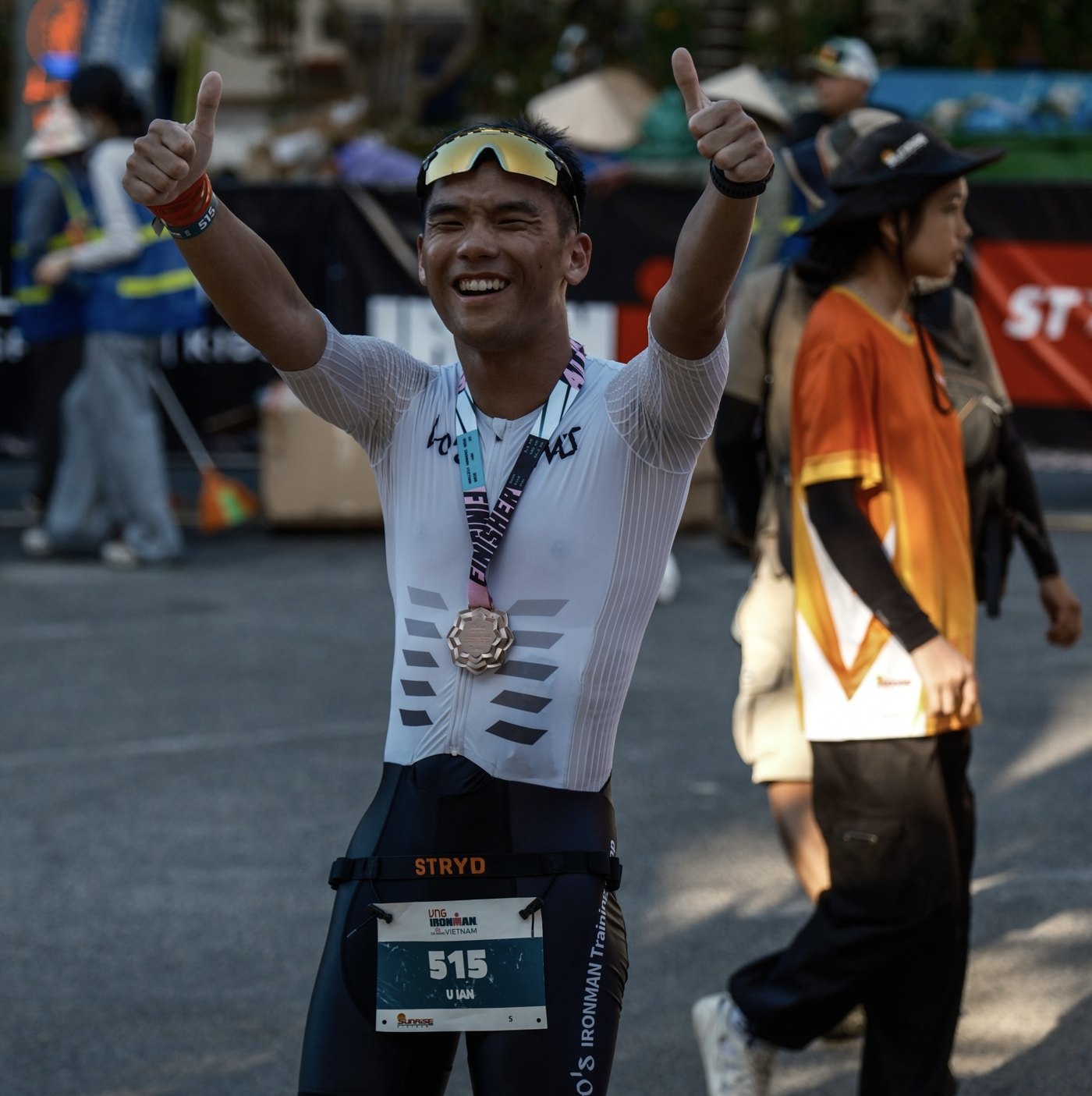
Finally, the clock on the finish arch stopped at 9:34:35. I was the 12th finisher overall and 2nd in M30-34, my best result ever in an IRONMAN-branded race. Factor in how tough the course and conditions were, and this was probably the best race I've ever had.


Unfortunately, under the new Kona allocation system, once my result was converted in the performance pool, I ranked only 40th. After the age-group winners, there were 15 slots left for the men's performance pool, and allocation stopped at 30th. I didn't get a Kona slot this year, and that stings. But that's what makes the World Championship worth something. The more it hurts when you miss out, the bigger the thrill when you finally get there! When something comes too easily, nobody values it (like the slots that were handed out so freely for the Nice World Championship). I'll get myself properly ready, and I'll definitely be back for another try!

There's still some regret. But mentally, I kept the promise I made to myself. I led by example, executed two full-distance races, and lived out what I preach about never giving up. And in the worst-case scenario, I chose to fight to the very end and wrote the best chapter of my racing career.

After two full-distance beatdowns, I didn't want to exercise at all the following week. And since I didn't get my World Championship slot, I suddenly had no goal for the second half of the year. I don't have any races planned right now. I just want to rest for a while. But I'll definitely be back on the start line soon. See you out there!