Ten years of coaching logic — and every plan reviewed by me
I took ten years of programming methods and real athlete data and built them into an AI training system. It writes your plan every week, and nothing reaches your calendar until I’ve read it.
A new plan every weekBuilt from the data you actually produced
Written in Traditional ChinesePace, power zones and execution notes, all spelled out
What You Get
What’s included
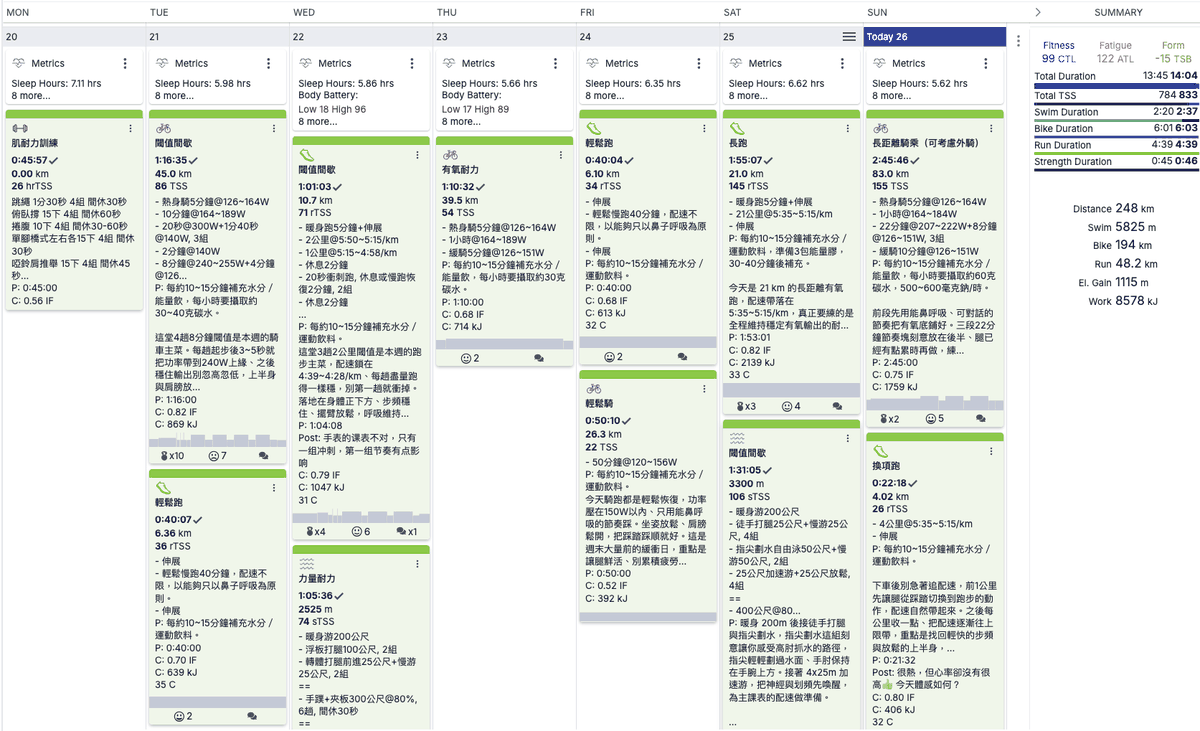
Plans are delivered through TrainingPeaks. Titles, sessions and intensity zones are all written out by me in Chinese, so you open the app and know exactly what today asks of you.
1
Your plans arrive in TrainingPeaks
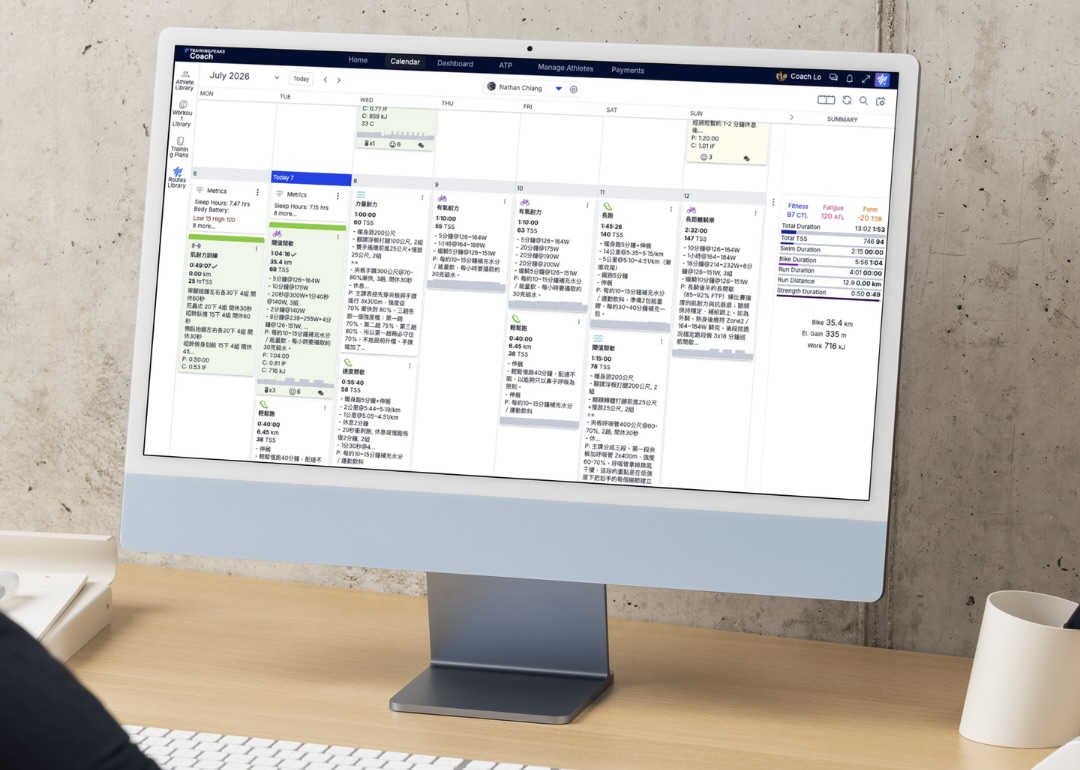
The platform triathlon coaches around the world work on. One tap syncs it to your phone, your computer and your GPS watch. Every session, every interval and all the data you produce live in one place, ready whenever you want to look back.
2
Every plan is written for you in Chinese
The TrainingPeaks interface runs in English. The plans themselves — title, session, intensity zones — are written out by me in Chinese, so a Chinese-speaking athlete can read a session start to finish without translating it first.
3
Every session says how to train it
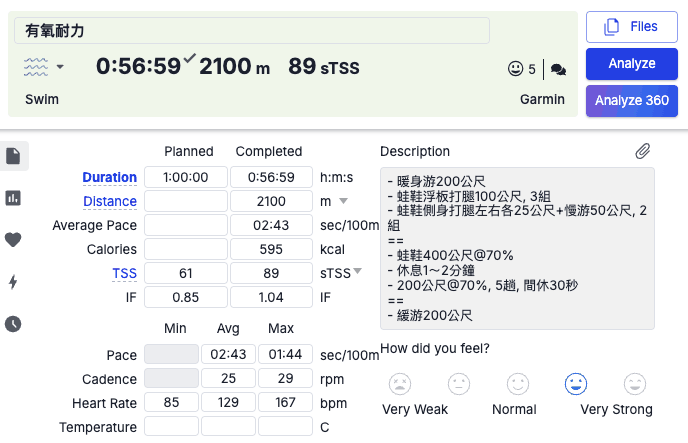
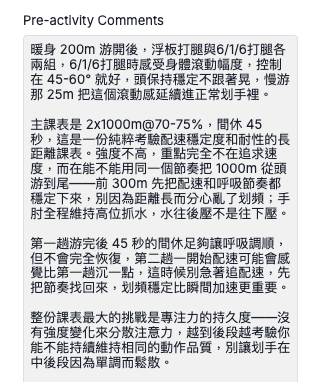
What the session is for, what pace and power to hold, what to watch for while you’re in it, how it should feel afterward. It’s all in the workout notes. Follow them and you’ll know the session landed where it was supposed to.
Weekly plans, reviewed by me personallyNext week's plan lands every Saturday. What you trained this week and where your fatigue sits both show up in what's in it.
One consultation a week, answered by meStuck on a session, not sure how to read your data, working out race pacing — ask through TrainingPeaks or email and you get a reply within 48 hours.
The plan moves with your lifeOvertime, travel, a body that feels off. Leave a comment asking for a change and the plan is updated within 48 hours of my review, up to four times a month.
Strength work, with a video for every moveStrength sessions are built in TrainingPeaks Strength Builder. Every exercise comes with a demo video and written instructions, so if you're not sure how a move goes, tap it and watch before you start. You log sets, reps, and weight right in the app.
Also included: regular field testing with zone updates, plus standard pacing guidance for your target race. Pro-level tools, explained in plain language, so you can train with confidence.
What you need to start: a GPS watch, a TrainingPeaks account and a pool you can get to regularly. A power meter on the bike is ideal, though heart rate is fine to begin with and we go through all of it together when you apply.
The Process
How it works
Who it’s for
✓Age-group athletes racing 51.5, 113, or 226 km
✓A clear goal race in the next 4 to 12 months
✓Time you can commit to training, week in and week out
If you’re chasing Kona, a PR, or a podium and want a coach on hand at all times, Premium 1-on-1 Coaching is the better fit.
01
You apply
Your training background, your results, your target race and the hours you can actually train.
02
We talk
Your goals, the time you have and where your training stands. We get going once we agree on the direction.
03
You pay, then we set up
Connect TrainingPeaks, import your training history, and get through the testing week.
04
The weekly loop
The system writes the plan, I review it, it goes out Saturday. You train.
↻ Every week
Built from data · Approved by the coach
When your fatigue is stacked too high, I rewrite the plan — or tell you to sit the week out. That’s what the review is for.
Weekly review, plus one training consultation a week (TrainingPeaks / email)
Message any time, priority replies, day-by-day tracking
Plan adjustments
Not possible
4 a month, within 48 hours
Unlimited, within 24 hours
Race plan
None
Standard pacing guidance
Custom course strategy and power plan
Strength training
None
Built in TrainingPeaks Strength Builder, with a demo video for every exercise
Built in TrainingPeaks Strength Builder, with a demo video for every exercise
Who it’s for
Athletes disciplined enough to read their own data and course-correct on their own.
Athletes who want a plan built around their own data, without needing a coach on call around the clock.
Athletes chasing Kona, a PR or a podium, who want a coach on hand at all times.
AI vs Lo's Tri Lab
Why not just write my own plans with AI? The difference shows up after the session — whether your data feeds into next week.
CASE A
Writing your own plans with AI
You type your situation into a chat box
The AI writes a plan from what you told it
You train it
Nobody ever looks at the data you produced
✕The loop stops here. Next week you open a new chat and explain yourself all over again.
Every round starts from zero, and the weeks behind you never make it into the next plan.
CASE B
Lo's Tri Lab Program
This week's completion, fatigue and progress flow back into the system
The system writes next week's plan on ten years of coaching logic
I read it myself, and revise it or call a stop where it’s needed
It goes out Saturday, you train it, and the data flows back in
↻Back to step 1. Every week is built on what you actually did the week before.
The longer you train, the fuller the record, and the closer each plan sits to the shape you’re actually in.
The Missing Piece
The missing piece is judgment
AI can read every training article ever published. What it can’t read is the athlete who says he’s fine while he’s quietly digging a hole, or the difference between fatigue you can train through and fatigue that has to stop today. Nobody has written those calls down. They live in the head of a coach who has worked with more than a hundred athletes 1-on-1.
The system can write plans because I fed ten years of decision-making into it, one rule at a time.
AI will give you anything you ask for, except the instruction to skip today. Ten years in, that’s the call I make more than any other.
Application and conversation first. Payment comes once we agree it’s a fit.
Same payment methods as the other programs: monthly card subscription, bank transfer, FPS (轉數快), Easy Transfer (過數易) or stablecoin. No refunds, but you can pause and pick it back up any time within a year.
The Proof
Ten years, starting with my very first athlete.
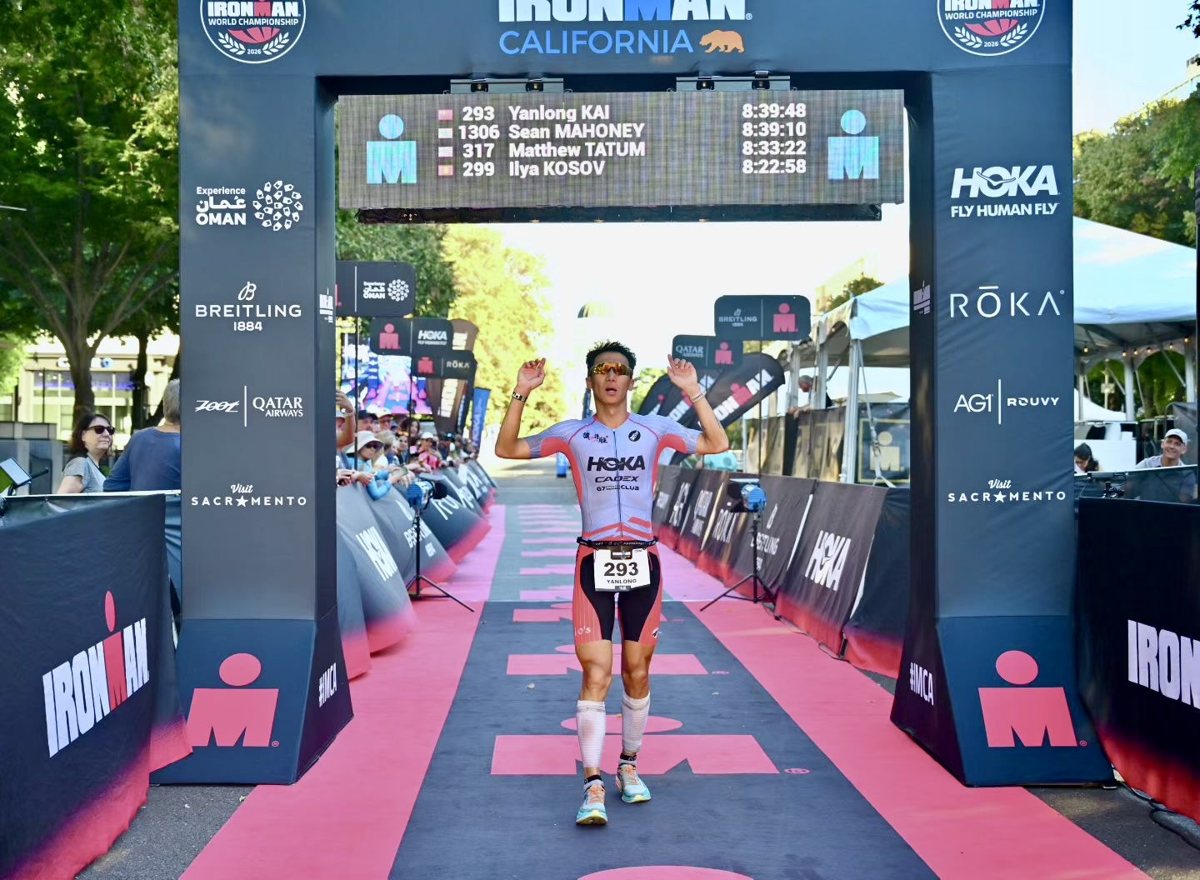
The athlete on the cover of this page is Yanlong Kai (開岩龍), the first triathlete I ever coached. In 2016 he was still in the 25–29 age group and, like most triathletes, wanted to race Kona one day. Every plan he’s trained on since then came from me.
Ten years on, he’s a veteran of the 35–39 age group and a father of two. He’s finished the IRONMAN World Championship in Kona four times and the Nice edition once. In 2018 he broke ten hours with 9:48:18, the seventh athlete from China under ten hours at the full distance (226 km).
At IRONMAN California in 2025 he broke nine hours with 8:39:48, fifth in M35–39. The hard part isn’t any single year. It’s stacking one on top of the next without a serious injury in between.
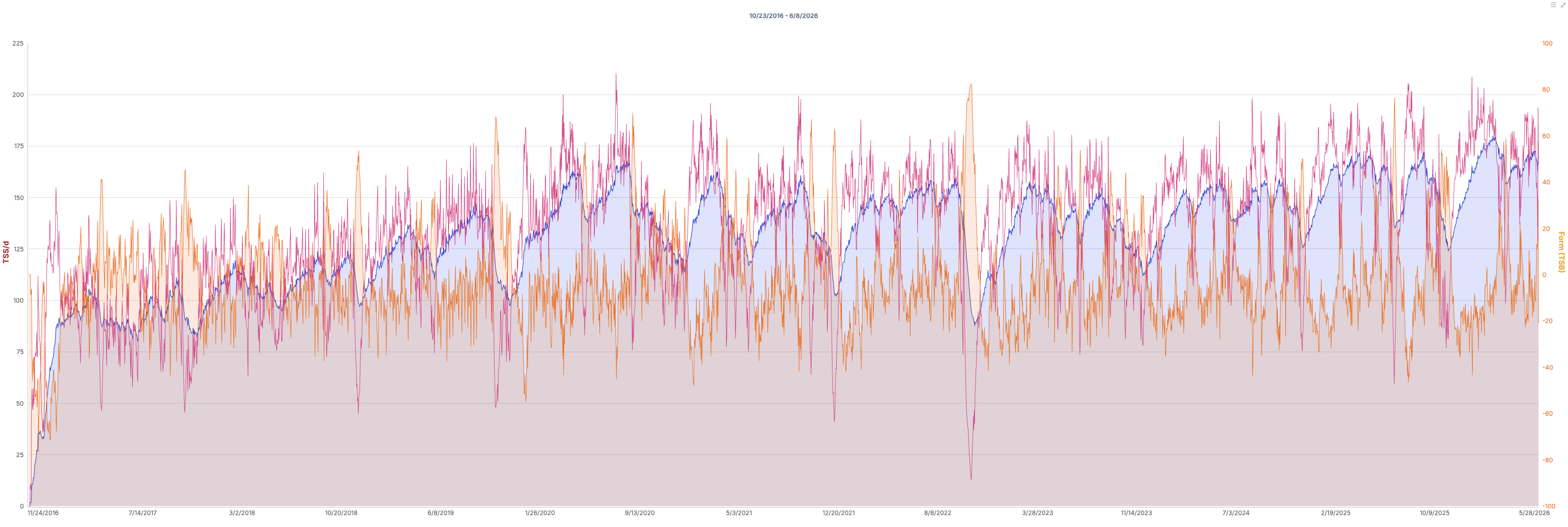
Ten years of Yanlong Kai's fitness curve, 2016 to 2026 (TrainingPeaks PMC). The blue line is CTL, the fitness you build day by day. It keeps climbing, and it never really breaks.
I’ve spent ten years refining this method, and the same ten years testing it on him. Beyond the results, what I value most from those ten years is the trust.
Yanlong Kai is one story out of many. Over ten years I’ve personally coached more than a hundred athletes 1-on-1, from first-time finishers to age-group podiums, and every one of those curves was built the same way. Now it’s a system, so more athletes can start drawing their own.
IRONMAN California 2025 · Sub-9
Yanlong Kai 8:39:48
The Story
“Coach Lo, you’re too expensive.” I’ve heard it plenty of times, and I suspect more people think it than say it.
Fair enough. With a 1-on-1 coach, the plan is the part you can see. What you’re actually paying for sits behind it: ten years of judgment about how your training cycle should be laid out, how to keep fatigue in check, when to push and when to stop.
Those calls are hard to copy. For a long time I assumed they couldn’t be.
In 2026 I did something I couldn’t do before. I took ten years of my own programming logic, tens of thousands of real training and race files, and the reasoning behind every plan I’ve ever revised, and built it piece by piece into an AI training system.
The system writes the plans. I check them. That’s how ten years of judgment reaches more athletes than my calendar ever could.
I’ve been coaching since 2016. Until now, this training only went to my 1-on-1 athletes. I want more triathletes across the Chinese-speaking world to be able to train on it.
The Name
Why "Lo's Tri Lab"?
Naming this program took me longer than writing a week of training for an athlete.
Start with Tri. It stands for triathlon — swim, bike, run. I’ve also always liked how close it sits to “try”. Every session and every race starts with being willing to try once. This program is a try of my own.
For ten years I’ve worked almost entirely 1-on-1. This time I’ve tried to turn a decade of method and logic into a system, so more athletes can train with a coach’s thinking behind their week instead of a document to follow.
Then Lab. Ten years in, I still don’t believe one plan fits everyone. Every athlete is a different case, and every plan should be observed, tested, corrected and then calibrated again. So I’ve always treated training like a lab. The data gives clues, the system runs the numbers, and I make the call based on experience that’s been tested round after round.
Finally, Lo's. That’s my surname; my full name is Lo U Ian (羅譽寅). It also marks where the responsibility sits: every plan the system writes and every adjustment it makes follows my standard, and when something goes wrong, it’s on me.
Lo's Tri Lab.
A try of my own, and a training lab that’s still being corrected.
Lo's Tri Lab
Standing alongside more athletes, into whatever comes next.
FAQ
Frequently asked questions
Can I trust a plan the system wrote?
The system doesn’t invent training methods. Every rule it runs on came out of ten years and tens of thousands of workouts I revised one at a time, and the data behind it was produced session by session by my own athletes.
It applies those rules to your week and drafts a plan. On Saturday I go through the drafts one by one, change what needs changing, and release them. What you’re trusting is my ten years.
Why not just use AI myself?
You can, and I’d encourage you to try. I use it every day. Three things tend to come up.
First, it doesn’t remember you. Every new chat starts over. How much you faded in the back half of last week’s long run, how much fatigue you’ve stacked up this month — none of that is there, so it can only answer from the few lines you typed. This system looks at what you actually put on TrainingPeaks that week and decides the next week from there.
Second, it won’t stop you. Ask for more volume and it adds volume. Ask for a session and it hands you one. Ten years of coaching, and the sentence I’ve said most often is “don’t train today”. Saying that takes someone who’s watching your data, remembers the niggle you had three months ago, and is willing to be wrong out loud at the exact moment you don’t want to hear it.
Third, and this is the big one. An athlete messages me: “Coach, I feel great today, I want to add a set.” Whether the answer is yes or no depends on his last two weeks of data and on what happened the last time he said that. AI has none of that memory, and nobody carries the consequences when it gets it wrong.
One more thing: an AI answer is only as good as the question, and training usually goes wrong exactly where you don’t know what to ask.
How is this different from an off-the-shelf plan?
An off-the-shelf plan is locked the moment you buy it. A cold this week, a work trip next week, a jump in fitness this month — it knows none of it, and you’re left guessing what to change and by how much.
Here, every week starts from the data you actually produced: completion, power, pace, where your fatigue sits. That decides what the next week looks like. For the same athlete, week three and week seven look different, because you’re different.
Do you really look at every plan?
Yes. Every Saturday I go through next week’s plan for every athlete, one at a time, and release them once I’ve made my changes. No exceptions. The weekly consultation is answered by me, personally.
I keep the roster small enough that I can get through all of it. Past a certain number, this step becomes a rubber stamp.
How is this different from Premium 1-on-1 Coaching?
The difference is how deep and how often I step in. The premium program has unlimited consultation, adjustments within 24 hours, and a course strategy customized down to each climb. This one runs on a fixed rhythm: plans go out weekly, and adjustments come as an allowance (4 a month, within 48 hours).
The training method is identical and I hold one standard. What changes is how fast you can reach me.
Can I move up or down?
Any time. Moving up to Premium 1-on-1 Coaching needs no review: pay the difference for that month and it takes effect. If you decide along the way that you want more support, just tell me.
It works the same going down. If you’re on Premium 1-on-1 Coaching and want to switch to this program, say so and it’s done. Training is a long road — some months you’re racing flat out, some months you’re ticking over, and the program should follow.
What if it’s full?
Get on the waitlist. When a spot opens up, the waitlist hears first.
Ten years of coaching judgment, written into your week.
Application and conversation first. Payment comes once we agree on the direction.