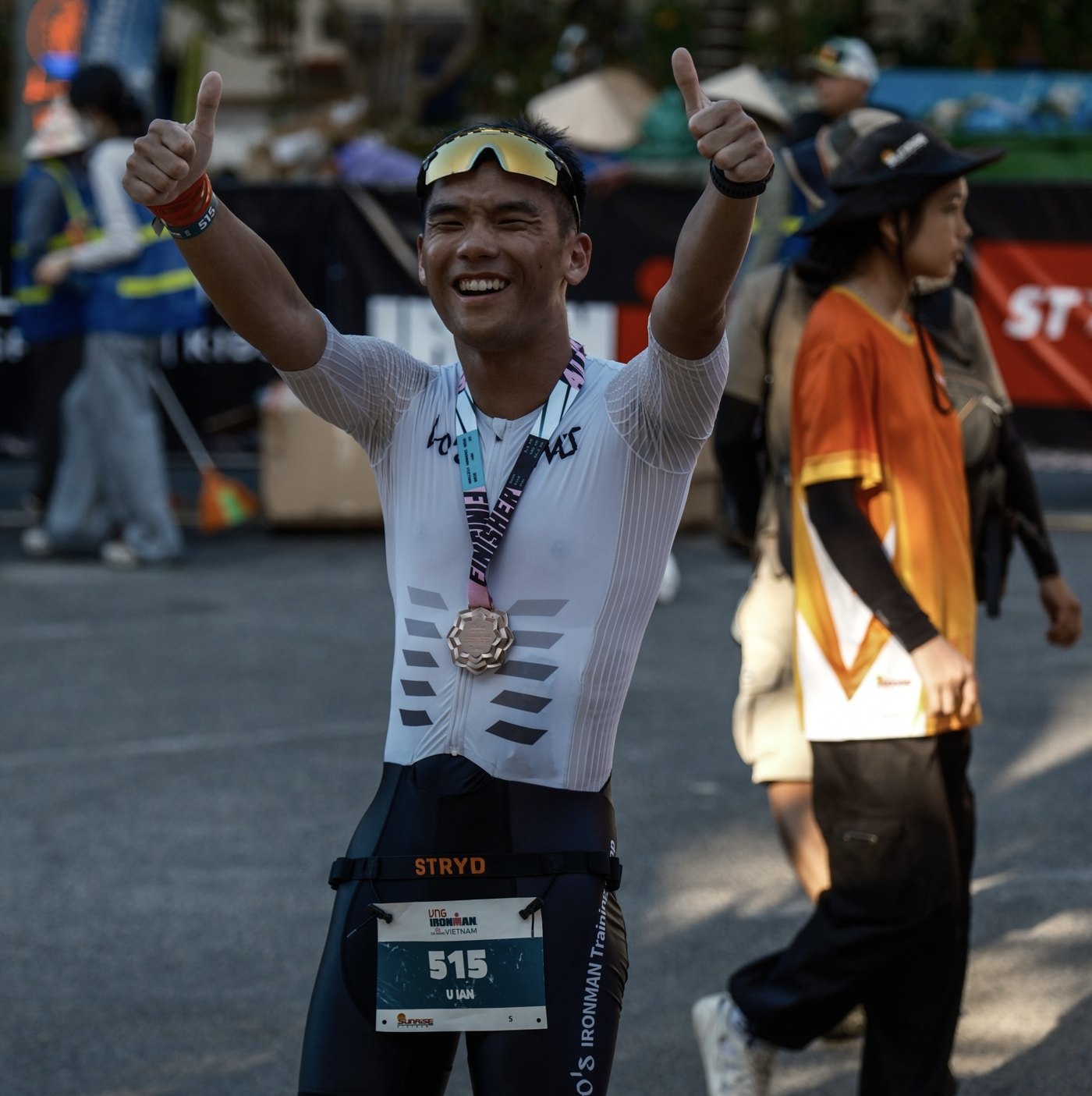

Start with a scene every triathlete has lived through. Before the start, you've jogged on the beach for 5 minutes, gotten in the water to loosen up your arms, and swum a few pickups. You come out with warm shoulders and your heart rate up, and you think, "Okay. I'm ready."
The start horn sounds and you dive in, and the first 200 meters feel like sleepwalking. You can't find your rhythm, your breathing's a mess, someone smacks you and you panic, and it takes a good while before you finally settle into your own stroke. By the time you're actually racing, you've often already lost ground.

And that's only the beginning. A triathlon is full of moments that take brainpower: sighting in the swim, pacing on the bike, scrambling through transition, timing your fueling, and finally pacing the run while switching your head over from riding. It all runs on the same brain.
Which raises a question. You warmed up your shoulders, your legs, and your heart and lungs. What about the brain that's in charge of pacing, fighting fatigue, focus, and decision-making? Did you warm that up?
I've been following this line of research closely lately, and the deeper I go, the more I think our understanding of warming up, and maybe even of training, has been missing an important piece of the puzzle.
We'll go from cognitive priming before a race, to how mental fatigue affects endurance performance, to Brain Endurance Training, which has started getting attention in recent years, and finally to the tool that took me a long time to build: NeuroPrime.
Sleepwalking Through the Start of the Swim: Is There a Fix?
One study happens to answer exactly that. A team at the University of Birmingham in the UK recruited 25 amateur runners. Each one ran three one-mile time trials under identical conditions, and the only thing that changed was the warm-up. In two of the three, the runners did about 3 minutes of cognitive tasks (on a phone app) before their physical warm-up.
The results were interesting.
With the cognitive warm-up added, the runners were about 2 to 3% faster on average (about 8 to 11 seconds). They also felt it was easier, their heart rate was actually 7 to 8 beats lower, and they rated their pre-race readiness clearly higher.
This is a small study with a small sample. The effect isn't small, but I think part of it likely comes from the psychological feeling of being ready.
In the study, the easy and hard versions of the cognitive task worked about the same, and that's an important clue. What helps may be getting your brain to switch smoothly into a state that suits performance before the race. Whether you wore it out along the way has little to do with it.

Whatever the mechanism turns out to be, the direction is clear: your brain needs a warm-up too. That's cognitive priming. It's closer to running your brain's startup sequence than to actual training.
A Lot of the Time, the Brain Gives Out First
To understand why, go back to a groundbreaking study from 2009. Marcora had subjects do 90 minutes of cognitive tasks to tire out their brains, then exercise to exhaustion. They hit exhaustion sooner, but their heart rate, lactate, and oxygen uptake didn't change at all. Only one thing changed: rating of perceived exertion (RPE).
In other words, mental fatigue changes your perception of effort. The muscles themselves are fine. At the same pace, a tired brain finds it more painful and harder, so you call it quits earlier. In 2014, Pageaux went further and found that response inhibition tasks in particular (Stroop, holding back from tapping when you shouldn't) are the most likely to cause mental fatigue, because they share some of the same neural machinery as your perception of effort during exercise.

That was a big wake-up call for my coaching.
When a lot of athletes blow up late in a race, it isn't necessarily the legs that go first. It's the brain starting to amplify the fatigue.
We often blame our fitness for giving out. A lot of the time, the first thing to surrender was the nervous system.
If Mental Fatigue Can Be Induced, Can You Train Against It?
This is the most interesting step. If mental fatigue drags down performance, could repeated training under mental fatigue make your brain more fatigue-resistant?
That's the idea behind Brain Endurance Training (BET), which has been getting more and more attention in recent years. A 2024 study by Innes found that after BET, performance improved on the trained task, and the gains even carried over to new exercise and cognitive tasks. In other words, brain endurance really does seem to be something you can build up step by step through training, just like muscle.

One really important caveat, though.
The evidence on BET is still piling up fast, and there still aren't many high-quality randomized controlled trials. A 2021 systematic review by Habay also found that responses vary hugely from person to person. Some people are naturally good at handling mental fatigue. For others, a little mental tiredness and their performance starts slipping. The only comparison that means anything, then, is against yourself, yesterday.
There's also a timing issue. It matters a lot, and it's the easiest one to get wrong. BET is a training stimulus, and it creates mental fatigue on its own. That's why you should never do a long BET session before a race, or you'll go to the start line with a tired brain. Before a race, do only a short cognitive priming session. Save the long endurance work for your training block.
So I Built NeuroPrime

Reading all this research, one question kept nagging me.
If these ideas really have value, how are athletes supposed to put them to use?
The app used in the research is commercial software, so I couldn't just copy it. But what's actually useful in the research is the types of cognitive tasks (response inhibition, task switching, memory updating, decision-making, vigilance), and those I could build. That's how NeuroPrime came about.
It basically turns the two ideas above into two modes:
- Cognitive priming: 2, 3, or 5 minutes before you train (3 is the one I recommend) to wake your brain up fast. At the end you get positive feedback on your state, so you can carry that "I'm ready" feeling to the start line.
- Brain endurance: 20 or 45 minutes of sustained cognitive load. It trains whether you can hold your focus, reactions, and decisions when you're tired, and it has nothing to do with IQ. At the end you get a "mental endurance" report that compares your reaction time drift and errors between the first and second half, to see how well you held up.

More than nine cognitive tasks rotate through (Stroop, green-go red-hold, changing rules, "same as the last one?", mental math, spot the difference, and more) so it doesn't get boring, and the difficulty adjusts itself. Get one right and the response window shrinks a little. Get one wrong and it opens back up a bit. In other words, you're always training at the edge of your own ability, never at someone else's standard.
There's also an RPE self-rating and trend charts (one line for your score and one for your average reaction time; real progress means one goes up while the other comes down). Then there's a "progress analysis" that tells you straight out whether you're improving, holding steady, or slipping, and honestly flags when there's "not enough data yet" so you don't jump to conclusions. After each session, one tap generates a results card image you can save to your phone or send straight to your coach.

That said, NeuroPrime does just two things. It helps your brain get into a performance-ready state faster, and it adds a kind of stimulus to your everyday training that very few people have ever really trained.
Real fitness still comes from the work you stack up day after day.


How Should You Use It?
Before training or racing, do cognitive priming only. I'd put it before your physical warm-up and have it done about 5 to 10 minutes before you start. Three minutes is enough. No need to go longer. If your goal is to build resistance to mental fatigue, use brain endurance mode. Put it in your training block, on its own or alongside easy aerobic work, 2 to 3 times a week, and build up the duration and difficulty gradually. Then open the trends page and watch your score climb week by week while your reaction time slowly comes down. That's the part that counts.

Next Time You Warm Up, Boot Up Your Brain Too
Back to that opening scene. Next time you're standing in the start corral, after your goggles are on, your heart rate is up, and your body's warm, don't rush into the water just yet. Ask yourself one thing: my body's fully warmed up, but the brain that has to swim, bike, and run the whole way with me, did I boot it up?
If the answer is no, then starting with your next warm-up, spend an extra three minutes.
After all, endurance sports are a contest between nervous systems as much as between muscles.
Appendix: Getting Started with NeuroPrime
NeuroPrime is a web app, so there's no App Store download. Scan the code with your phone or open the link and you're in. You can also add it to your home screen and use it offline.
- Open it: scan the QR code below with your phone, or tap the link https://neuroprimetw.netlify.app
- Put it on your phone: on iPhone (Safari), tap "Share" at the bottom → "Add to Home Screen." On Android (Chrome), open the menu → "Add to Home screen / Install app."
- Start using it: before training or a race, tap "Standard routine · 3 minutes" for cognitive priming. To train fatigue resistance, pick "Brain endurance," 2 to 3 times a week. It opens full screen and works offline.

References
- Marcora, S. M., Staiano, W., & Manning, V. (2009). Mental fatigue impairs endurance performance in humans. Journal of Applied Physiology, 106(3), 857–864.
- Pageaux, B., Lepers, R., Dietz, K. C., & Marcora, S. M. (2014). Response inhibition impairs subsequent self-paced endurance performance. European Journal of Applied Physiology, 114(5), 1095–1105.
- Van Cutsem, J., et al. (2017). Effects of mental fatigue on physical performance: A systematic review. Sports Medicine, 47(8), 1569–1588.
- Smith, M. R., et al. (2016). Mental fatigue impairs soccer-specific physical and technical performance. Medicine & Science in Sports & Exercise, 48(2), 267–276.
- Martin, K., et al. (2018). Mental fatigue impairs endurance performance: A physiological explanation. Sports Medicine, 48(9), 2041–2051.
- Habay, J., et al. (2021). Interpersonal variability in the effects of mental fatigue on physical performance: A systematic review. Sports Medicine, 51(12), 2581–2598.
- Innes, K. I., Graham, J., Brown, D., & Bray, S. (2024). Brain Endurance Training improves dynamic calisthenic exercise and benefits novel exercise and cognitive performance. Journal of Strength and Conditioning Research, 38(10), 1102–1111.
- Cognitive fatigue disrupts explosive performance and vigilance in trained individuals (2025). PubMed Central, PMC12656399.
- Díaz-García, J., et al. (2024). Effects of isolated and combined mental and physical fatigue on motor skill and endurance exercise performance. Psychology of Sport and Exercise, 75, 102720.


